
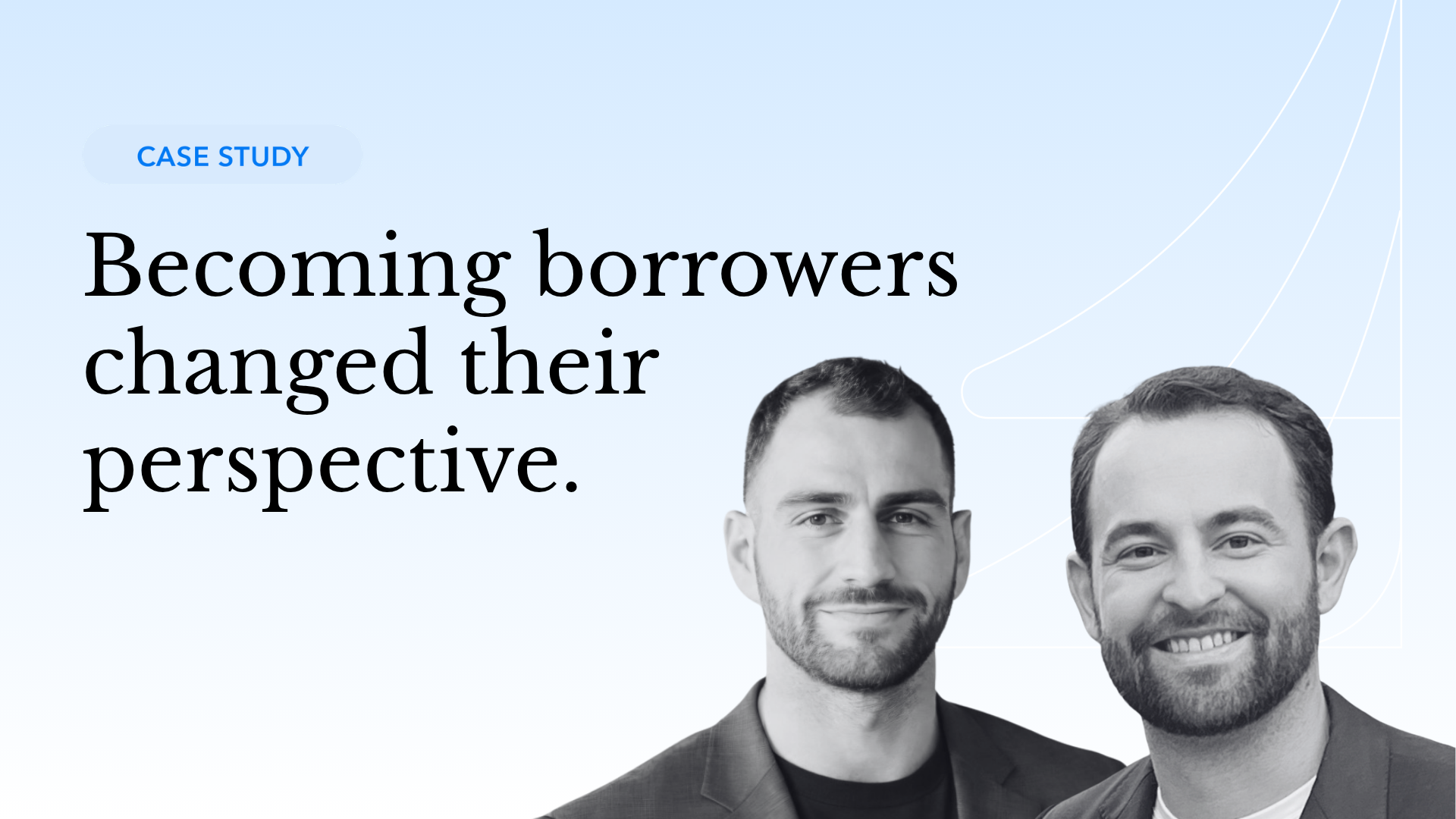
Two Friday Harbor engineers became borrowers and discovered that AI’s greatest strength isn’t replacing human expertise; it’s making more room for it.
In early 2026, two Friday Harbor engineers got the kind of opportunity software developers rarely experience: the chance to ‘dogfood’ their own product during one of the biggest financial transactions of their lives.The term, popularized by Microsoft in the 1980s, refers to the practice of using your own technology internally before asking customers to rely on it. But Yannis Katsaros and Paddy Quinn didn’t just run internal tests or stage demos, they used it for one of the highest-stakes financial transactions of their lives: buying homes for their growing families.
As the lead software architect and a founding engineer, the duo have touched nearly every part of how the platform works, from the moment documents are uploaded, through the AI analysis that surfaces findings, to the conditions that land on a loan officer’s screen. They know the system as well as anyone.
But it turns out, knowing the system is different from using it.
One shared loan officer, two different borrower profiles
Both engineers chose to work with Jim Carroll at Partners Bank, one of the platform’s most engaged customers and a champion of Friday Harbor from its early days. As head of home lending at Partners, Jim is not only a licensed loan officer of 30 years, he’s also an underwriter. This meant he reads every condition Friday Harbor surfaces with an expert’s eye, from large deposits to undisclosed debts to appraisal discrepancies.
Sharing a loan officer created a natural point of comparison for Yannis and Paddy. Their files, however, could not have been more different.
What made their files complex
| Yannis Katsaros, Founding Engineer | Paddy Quinn, Lead Software Architect |
|---|---|
|
|
Yannis’ story
This was Yannis’ third home purchase. His file looked conventional on the surface: a conforming loan, a co-borrowing spouse with steady W-2 income, and a clean close date in sight. He expected the experience to be familiar.
So when the initial loan application review came back with 15 conditions, his first reaction was disbelief. “What is this? I thought: there’s no way,” says Yannis. Then he started reading through them. “It’s not that the platform tries to ding anyone. It’s just surfacing everything the loan officer needs to see before they can feel confident closing the file.”
All the conditions turned out to be correct calls. Down payment figures in the contract and Uniform Residential Loan Application (URLA) were off, which Friday Harbor caught immediately on upload. Because Yannis planned to buy his new home before selling his current one, the platform also identified the documentation needed to demonstrate how the two properties would be treated during the transaction. Bank statements were flagged for what appeared to be undisclosed accounts (actually his parents’ accounts, resolved with letters of explanation). Each condition was the platform doing exactly what it was built to do: alert the loan officer to considerations that needed to be addressed before moving forward.
Because Jim had visibility into the full file from the start (discrepancies, documentation gaps and all), there was nothing to chase down. Their conversations were focused and productive with a straightforward list of points to work through together well before closing day.
Paddy’s story
Paddy’s situation, by contrast, was never going to be simple with unseasoned bitcoin holdings, locked IPO stock, a plan to keep his current home as a rental, and a loan amount that pushed into jumbo territory.
“I knew going in that my situation wasn’t straightforward. That was kind of the point. If the system could handle my file, I’d know something real about what we’d built,” Paddy says.
The platform identified the documentation and seasoning requirements surrounding Paddy’s crypto assets almost immediately. More importantly, those findings revealed that his financing needs required a loan product Partners Bank wasn’t structured to offer. Instead of discovering that weeks later (or at the closing table), Jim was able to refer Paddy to a broker with access to products better suited to his situation.
The loan ultimately closed with another lender, but that was exactly the point. Friday Harbor surfaced the mismatch early enough that Jim could help Paddy find the right path before anyone invested weeks pursuing the wrong one.
What AI gave back to the loan officer
Despite having very different loan scenarios, Yannis and Paddy described the same experience with Jim: because Friday Harbor handled much of the document analysis up front, Jim spent less time gathering information and more time helping them make decisions.
Yannis put it directly: “He didn’t have to waste his time on things that were already in the documents or could have been resolved on his side,” such as document questions or manual calculations. He ran the file through Friday Harbor, quickly reviewed the initial findings, and then discussed what those findings meant with Yannis.
For Paddy, the value was in the timing. Crypto asset seasoning comes with requirements that need lead time to plan around, and Friday Harbor surfaced them early enough for Jim to find a fix. The conversation shifted from troubleshooting to problem-solving before it ever became urgent.
What a real loan taught the engineers
Being a borrower solidified the product’s value in a way that building the system had not.
Paddy’s non-conventional lending path reinforced the urgency of a system that can ingest guidelines for any loan type, not just the standard Fannie, Freddie FHA, and VA programs most platforms support, and underwrite accordingly. Yannis’ was able to evaluate each issue Friday Harbor surfaced with the full context of his own financial situation, and understand precisely what the platform was doing and why.
“There are so many intangibles you pick up when you’re both the borrower and the engineer,” Yannis says. “Things Jim didn’t know that I could only see because I’m the one who knows what that additional bank account actually was. That’s not a failure of the system. But it showed me exactly where we can do better.”
The human side of AI
Neither engineer came away believing great technology makes great loan officers less important. If anything, the experience convinced them of the opposite.
By handling document analysis, guideline evaluation and condition identification, Friday Harbor gave Jim more time to do the work only a human expert could do: understand each borrower’s situation, explain their options and guide them toward the right outcome—even when, in Paddy’s case, that meant recommending a different lender.
That experience is already influencing how Paddy and Yannis continue to build the platform. After seeing Friday Harbor through a borrower’s eyes, they’re refining not just what the system finds, but how it communicates those findings to the people who rely on them every day.